
V E I K K A S A A R I S T O
L E V E L D E S I G N E R | H E / H I M
PORTFOLIO
BANDIT POINT (2019)
I worked at Mantisbite as Lead Level Designer / Game Designer on the project. I was responsible of realizing all of the game's levels (10 full levels, 20+ scenes) from concept to finish. My process was as follows: initial sketching (rough architecture / map overlook), advanced sketching (enemy placements, spawner locations, engagement design), initial greyboxing (including spawner placement & testing), polishing environment (modeling buildings, grounds, stairs, cleaning models of extra vertices etc.), UV mapping, texturing & decorating, lighting (including baking lightmaps), and finally wiring level logic (triggering for all interactions, doors, trigger areas and such, polishing spawns etc.), followed by intense testing, polishing and reiterating, returning to any of the previous steps as needed.
Below are some of my level design documents and rough level sketches from Bandit Point.


Working in a small indie team with a limited timeframe and budget meant optimizing and re-using as much work as possible. Several levels in Bandit Point were re-used in a later part of the game for this reason, so locations had to be designed to be traversed in both ways, working one way with limited enemy units at earlier parts of the game, and later in another with more unit variety. We were able to reuse multiple levels with small changes to decorations and a different lighting scheme to change the levels' appearance without changing architecture, still maintaining the sense of familiarity, as revisiting locations was tied to the story. Best cases of reusing the same set piece to create multiple levels would have been the ship combat levels, in which the player is fighting against enemy ships on the Bandits' own ship. As the ships were ready, modeled assets, creating new ship combat levels allowed me to skip the greyboxing and modeling stages entirely, only having to redo lighting in order to change the time of day, designing the combat scenarios and wiring new triggers for them. Each ship combat level plays out differently and ends in a different outcome to avoid repetition through reuse of the set pieces. I had my hand in designing the architecture of the ships' decks, creating cover points and different sight lines in different parts of the deck, keeping the combat interesting through multiple levels set in the same environment.
I modeled a whole bunch of buildings for the game's city scenes, that could be re-used in the most ways possible in order to optimize work. The models were kept pretty low-poly to keep their hit to performance low as in VR it's already an issue. I modeled most of these to fit a big city scene, and then extracted them for use as prefabs in other levels. Below are also a few building sketches that I drew as either direct concepts or to establish a more general approach to the architectural style I went for in the game.


On HyperVisor, I worked as lead game/level designer, but also as a 3D artist, designing and modeling all buildings and interiors in the game, samples seen below.


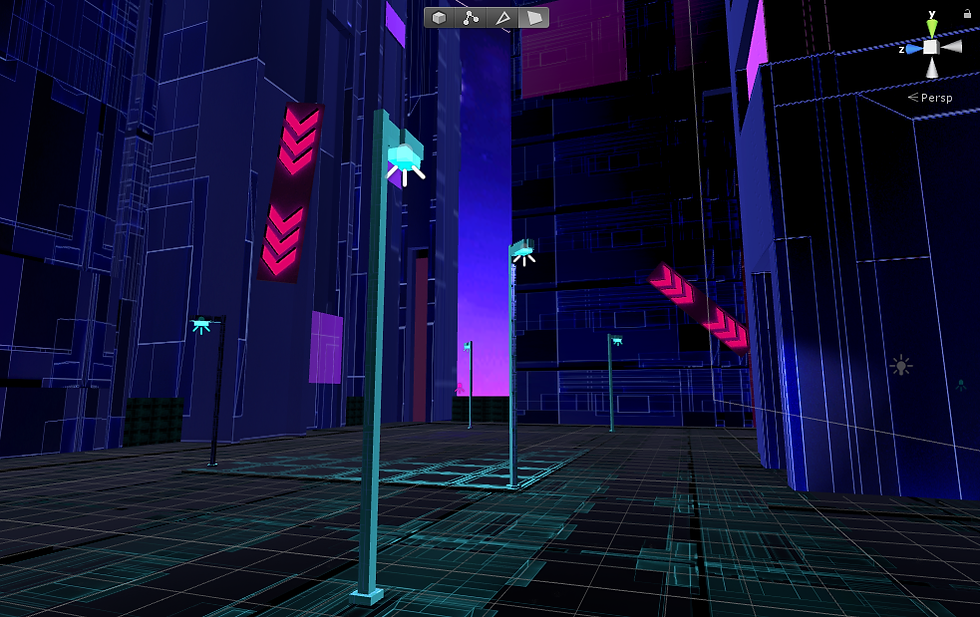

I did all modeling using ProBuilder inside Unity and kept it all very low poly to maximize performance in VR. The game has an intro scene, where the player can pick out two weapons of their choice to holster, and two to hold in their hands before moving either to the tutorial or to the actual game. The tutorial encompasses the basic mechanics of the game, teaching the player how to shoot and confront the different enemies. The main gameplay takes place in a 80's retro-futuristic city indulged in neon, consisting of a single scene with multiple plazas, corridors and streets for the player to move around in, while hunting down the invading robots. This exchange of narrow and wide, open spaces and always having multiple routes around the player where they could be ambushed by enemies was designed with the intention of keeping the player on their toes and constantly moving around in the level.
As the player runs out of ammo, they must throw away their empty weapons and pick up new ones from weapon spawners sprinkled around the neighborhood. The idea of reloading the weapons was thrown around, but was abandoned in favor of more action packed gameplay where the player is in constant search of new weapons. This also forces the player to change around their weaponry instead of relying on their favorite gun for the whole game as a weapon spawner may not give the weapons that you expected or wished for. I arranged the spawners in open places with no proper cover where the player is quite vulnerable for enemy fire in order to minimize camping around them and forcing the player to move around in search of new weapon spawners in order to avoid the situation where they're caught empty-handed by a horde of hostile robots.
The experience and know-how gained from and sparked by this project proved invaluable in future endeavors, as I got the job of Level Designer (eventually turning into the title of Lead Level Designer / Game Designer) at Mantisbite due to my experience in 3D level design in Unity and ProBuilder.
SCAMPER (2016)
I worked as Level Designer on Scamper, in addition to being the secondary programmer and audio designer.
Some sketches and level design documents can be found below:
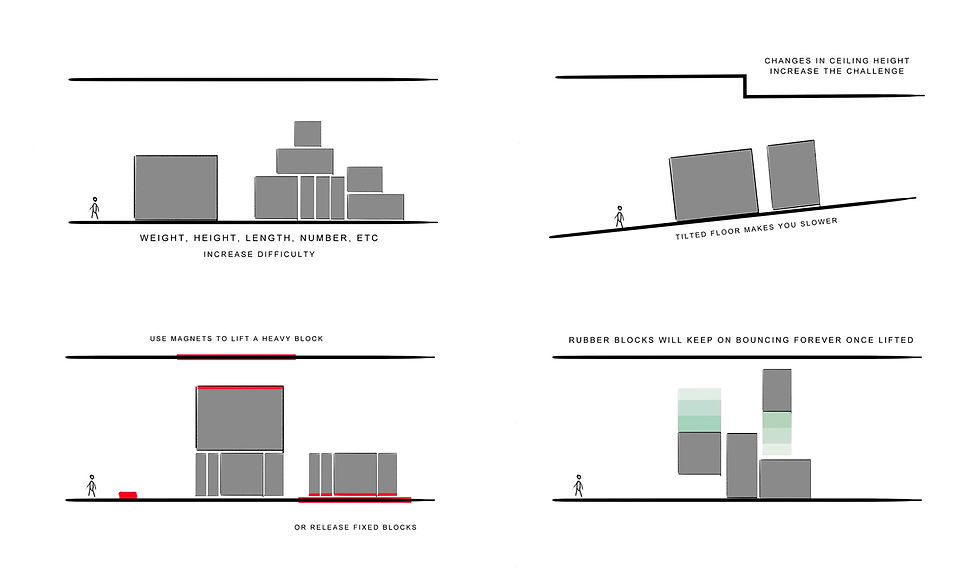

The game is divided to four parts, or "days", each introducing new mechanics to the game, with puzzles increasing in challenge as the player progresses through the game. Each day has 10 puzzles, making for 40 levels in total.

Day 1 works as a tutorial section, where the player is taught the basics of the game. The first 10 puzzles involve moving boxes out of the way by bouncing them up in the right time, clearing a route for the rat to run through. Stacked boxes create variance to the puzzles by making the player think which boxes to move and in which order, as some may bounce off others or require others to be moved before they can be manipulated themselves.
Day 2 introduces swinging boxes that the player must avoid, creating specific time windows that the player has no longer full control of, surfable boxes with safe surfaces on top of them: bumping into their sides still proves fatal, but by standing on top of them and moving them the player could cross gaps and other dangerous situations, and fans that cause the rat to float in the air, avoiding ground-based dangers and gaps entirely, especially by moving the fan boxes under them while moving.
Day 3 introduces magnets and buttons that activate them. By bumping the buttons with a box, magnets are turned on, locking boxes in different positions and moving them across the screen, allowing for increased variance in the puzzles.
Day 4 introduces lethal electric beams that the player must avoid at all costs and levers to turn them on or off, combining all previously introduced mechanics to create the hardest puzzles the game has to offer. The last levels require very precise timing and manipulating multiple different mechanics at the same time as we were going for skill-based difficulty involving reaction speed and multitasking skills, being able to take into notion different mechanics all at once.
Earlier levels allow the player to clearly test the whole box moving sequence through first, creating a clear route for them to run through, with later levels requiring the level to be manipulated during the run, as the route closes behind the player.
Below are some more detailed examples of puzzles in the game, showcasing the different mechanics in the game and player thought patterns needed to complete them.

In this puzzle, the rat must run on top of the walkable box (green arrow) and move it until it's on top of the up-facing box (blue arrow), which in turn must be moved up in order to swing the rat over the column in the middle. The rightmost box (red arrow) must be swung away from the path in the right time to clear the route, but not too early as it will swing back!

In this puzzle introducing magnets to the player, they must move the top-most box (red arrow) first for it to hit the button that will turn on the magnet in the ceiling (marked with yellow and black lines), which will in turn pull up the magnetic boxes (marked with the yellow circle), after which this is a straightforward puzzle not unlike the first ones, where the two boxes on the floor (green and blue arrow) must be bounced up at the right time to clear a route for the rat.

This puzzle offers multiple possible solutions; the point here is blocking the electric beam in the middle with a box while bouncing up the rat with another box in order to gain enough air time to reach the exit corridor. As the beam comes from the right, the rightmost boxes must be used for blocking it while bouncing the rat up with the leftmost ones.
In this puzzle, the rat must run on top of the walkable box (green arrow) and move it until it's on top of the up-facing box (blue arrow), which in turn must be moved up in order to swing the rat over the column in the middle. The rightmost box (red arrow) must be swung away from the path in the right time to clear the route, but not too early as it will swing back!
KIWI RUSH (2015)
The levels in Kiwi Rush were procedurally generated, randomizing from a set of segments pre-made by me. Each segment is some five to fifteen obstacles long with adequate space between, and each area in the game would randomize segments from sets categorized by environment and difficulty, certain environments being more difficult than others.
The segments were simply written in text files, and would look like this (example segment MushroomHard1):
oxo
o-o
--o
---
xxx
oxo
xox
xo-
-xx
-o-
oox
-o-
o-o
--o
o--
(where o means obstacle, x deadly obstacle and - an empty space)
In Kiwi Rush, regular obstacles can be jumped over, where as deadly obstacles can't. The player character (kiwi) jumps automatically over regular obstacles if there are jumps left. Player gathers jumps by solving quick mental calculations while controlling the kiwi through the dangerous environments.
There were three different environments/biomes in the game: forest (default, starting location), desert (forest turns into desert once in a while) and mushroom forest (accessible by eating a rarely spawning magic mushroom). Each environment had 5 different segment sets per difficulty (Easy and Hard), equaling to 30 unique sets in total.